
What to Bring to Baltimore Rent Court: The 2026 Landlord Hearing-Day Checklist
Baltimore City rent court hearings are decided in five to ten minutes. Whether you win depends on what you walk in with. This is the 2026 landlord checklist, updated for the October 2025 courthouse relocation to 500 N. Calvert Street, with every document the judge expects to see and the procedural traps that catch unprepared filers.
On this page
Baltimore City rent court hearings move fast. Most uncontested cases are decided in five to ten minutes. Whether you win or get dismissed depends almost entirely on what you walk in with, not on how you argue. This is the 2026 hearing-day checklist for Baltimore landlords, updated for the October 14, 2025 courthouse relocation to 500 N. Calvert Street.
Baltimore rent court is decided at the document table, not at the bench. Show up with everything the judge expects, and the case takes ten minutes. Show up missing the rental license, and the case dies before you can speak.
The Failure to Pay Rent hearing process is governed by Md. Code, Real Property § 8-401 and the Maryland Rules of Procedure. The Baltimore City District Court provides housing-case guidance at mdcourts.gov/legalhelp/housing. The 2025 courthouse move is documented at mdcourts.gov/baltimoredcmove. For the upstream process leading to this hearing, see The Maryland FTPR Process, Step by Step.
The 2025 Courthouse Move (Critical for First-Time Filers)
The Baltimore City District courthouse moved from 501 E. Fayette Street to 500 N. Calvert Street, Baltimore, MD 21202 effective October 14, 2025. If you have been filing in Baltimore for years, the muscle memory is wrong. Update your route, your security expectations, and your parking plan.
A few practical notes for the new building:
- Parking is limited around the Calvert Street location. Plan for a paid garage or rideshare. Street parking in the area is metered and time-limited.
- Security screening runs similar to the old courthouse but the new building is still operating on extended screening protocols in its first year. Allow 30 to 45 minutes to enter the building on busy docket days.
- Rent Court Division signage inside the new courthouse will direct you to the correct courtroom. Ask building security at entry if uncertain.
The Document Checklist
The eight items below are mandatory for any Baltimore Failure to Pay Rent hearing. Each one is a documented dismissal cause when missing. Print physical copies; do not rely on phone screens for the core documents.
1. The original signed lease
Original (or notarized copy) of the lease with all signatures. The judge will look at: the parties named, the rent amount, the rent due date, late fee terms, and the lease term. Oral tenancies present additional complications; bring any written documentation of the agreement (rent receipts, payment app records, written amendments).
2. Updated rent ledger through the filing date
A line-by-line ledger showing: every rent payment received, every late fee assessed, every credit applied, and the running balance. The amount on this ledger as of the filing date must match the amount claimed on DC-CV-082. If a partial payment came in between the 10-day notice and the filing date, the ledger must reflect it.
For the math behind late-fee compliance with the 5% statutory cap, see Maryland's 5% Late Fee Cap.
3. Proof of 10-day Notice of Intent service
Documentation that you served the 10-day Notice of Intent under Md. Code, Real Property § 8-401(c):
- Personal service: signed acknowledgment or witness statement
- Posting: photograph of the notice posted on the door, date- stamped if possible
- Certified mail: signed return receipt (green card) or USPS tracking record
The judge will ask to see this. Notice service is the single most common dismissal cause statewide. For the full notice requirements, see Maryland's 10-Day Notice Requirement.
4. Current Baltimore City rental license
The license number must already appear on DC-CV-082 (it is a required field). Bring physical evidence of the current license in case the clerk or judge asks to verify. An expired license is an automatic dismissal at the bench.
For the full Baltimore City rental license framework including the 2026 Strengthening Renters' Safety Act changes, see Baltimore Rental License Dismissed Eviction.
5. Current Maryland Lead Paint Inspection Certificate (pre-1978 properties)
For any rental property constructed before 1978, the Maryland Department of the Environment requires a current Lead Paint Inspection Certificate, and the certificate number must appear on DC-CV-082. Bring physical evidence. An expired certificate is the second most common Baltimore-specific dismissal cause after rental license issues.
6. Photo ID
Government-issued photo identification (driver's license, state ID, or passport). Required for building security at entry, and sometimes requested by the clerk to verify the plaintiff's identity.
7. The filed DC-CV-082 with case number
A copy of your filed complaint with the case number assigned by the clerk. The case number is on the court summons sent to the tenant; bring that document as well. For the field-by-field breakdown of the form itself, see How to Fill Out DC-CV-082.
8. Tenant communications relevant to the arrears
Text messages, emails, voicemails, or written letters that document: rent reminders, partial payment offers, habitability complaints (and your response), maintenance requests, lease discussions, or any other relevant context. Print physical copies. If the tenant raises a defense at the hearing, these communications are often the deciding evidence.
Optional Documents (Helpful When Relevant)
Bring these if applicable. They are not mandatory but can resolve common questions before they become problems:
- Property deed (if you are filing as personal owner and the tenant raises a standing question, or if your case involves an LLC where the deed and lease names differ)
- Property inspection reports (defense against habitability counterclaims)
- Repair receipts and dates (same)
- Section 8 voucher documentation including HAP contract (for Section 8 tenants; see Section 8 Eviction in Maryland)
- Late fee calculation worksheet showing the math against the 5% statutory cap per delinquent rental period
What NOT to Bring
A few things consistently work against landlords at rent court. Leave them at home:
- Character evidence about the tenant. "He's been a problem neighbor since day one" is not relevant to whether rent was paid. The judge cares about the four corners of the lease and the rent ledger.
- Unrelated lease violations. Pet violations, noise complaints, and other non-payment issues belong in a different case type (Breach of Lease or Tenant Holding Over), not FTPR.
- Emotional appeals. Rent court is a paperwork forum. Bring the documents, not the story.
- Children. Most Baltimore rent court judges discourage bringing children. Arrange childcare if at all possible.
- Recording devices. Photography and audio recording are prohibited in Maryland courtrooms without permission.
Hearing-Day Logistics
When to arrive
Plan to enter the building at least 30 minutes before your hearing time. On busy docket days (Mondays and the first week of the month see the heaviest volumes), allow 45 minutes for security.
What to wear
Business casual. A collared shirt, slacks, and clean shoes are appropriate. Avoid:
- Shorts, athletic wear, beach attire
- Clothing with offensive imagery or political messaging
- Hats inside the courtroom (per Maryland court etiquette)
What to expect at check-in
You will check in with the courtroom clerk before the docket begins. The clerk will confirm your case is on the day's docket and verify your appearance. Sit in the gallery until your case is called. Cases are typically called in the order on the docket sheet, with some prioritization for represented parties or default cases.
What to expect at the document table
When your case is called, approach the table with all your documents organized. The judge will typically ask:
- "Is this your lease?"
- "Is this your rent ledger?"
- "Is the rental license current?"
- "Did the tenant receive the 10-day notice?"
Answer crisply. Hand documents to the bailiff or the judge as requested. Do not interrupt; do not volunteer beyond the question asked.
The Four Possible Outcomes
1. Default judgment for possession
The most common outcome. Tenant does not appear; you do, with your documentation. The judge enters a money judgment for the rent amount and grants possession. The 7-business-day post-trial wait starts running.
2. Judgment for possession with tenant present
Tenant appears but does not contest the rent amount or raises only a hardship argument the court cannot consider. Same procedural result as default: money judgment plus possession.
3. Continuance
Tenant appears with a credible defense or requests time for counsel (Access to Counsel in Evictions program, legal aid). Judge resets the case 2 to 4 weeks out. Bring everything back on the new date.
4. Dismissal
Missing prerequisite (rental license, lead paint certificate), defective notice service, wrong amount on DC-CV-082, or another procedural defect surfaces. Case dismissed. You refile from the 10-day Notice of Intent, losing the filing fee and 2 to 4 weeks of timeline.
For the full timeline implications of each outcome, see How Long Does an Eviction Take in Maryland?.
Settlement on the Record
Baltimore City District Court offers mediation through its Alternative Dispute Resolution (ADR) program for FTPR cases. If you and the tenant reach a payment plan, the agreement can be memorialized as a consent order entered on the court record.
Key points about consent orders:
- They are enforceable by the court
- Default triggers immediate execution without further notice
- They typically include: payment amounts, due dates, default consequences, and a vacate date if payment is not made
- Either party can be represented during the consent negotiation
Settlement is often the cleaner outcome for cases where the tenant is willing and able to catch up. The case is paused contingent on performance; if the tenant honors the plan, the case is satisfied. If not, the consent order itself becomes the judgment.
How EvictPro Prepares Your Hearing-Day Package
EvictPro's Court Hearing stage includes a hearing-day document package built from your case file, so you walk in with every required item printed, organized, and tabbed. The same workflow handles a single landlord's first hearing and a firm portfolio manager's dozenth.
What's in the platform-prepared package
- Document checklist with every item from the list above, pre-printed and tabbed for fast retrieval at the document table
- Rent ledger auto-computed to the filing date with late fees capped at the 5% statutory threshold
- Notice service proof retrieved from the case file (the Notice of Intent generator timestamps service automatically when used through the platform)
- Rental license and lead paint certificate verification as of the hearing date, with renewal alerts if either is approaching expiration
- Experienced agent appearance at the hearing on your behalf if you select the Court Hearing stage with representation included
- Post-hearing tracking for the 7-business-day post-trial wait and the two 60-day warrant clocks
Stage-based pricing (court fees inclusive)
- Notice of Intent: $0. Free tool, no account required
- Filing with Court: $99. DC-CV-082 prep plus filing plus court fee
- Court Hearing: $249. Hearing representation plus document package plus on-the-record support
- Warrant of Restitution: $199. DC-CV-081 prep plus filing plus court fee
- Sheriff Scheduling: $75. Sheriff coordination
- Eviction Day: $225. On-site presence for the physical eviction
Or bundle with Full Eviction Service: $749. Every stage above included, end-to-end. The base court filing fee is inside each stage price. Maryland's $5-per-tenant filing service fee (DCA-109) is billed separately at cost.
Related reading:
- The Maryland FTPR Process, Step by Step
- How to Fill Out DC-CV-082: A Field-by-Field Maryland Filing Guide
- Maryland's 10-Day Notice Requirement
- Baltimore Rental License Dismissed Eviction
- Maryland's 5% Late Fee Cap
- How Long Does an Eviction Take in Maryland?
- What Does a Baltimore Eviction Actually Cost in 2026?
Ready to file with a clean document trail that gets you to the hearing prepared? Start with a Notice of Intent that timestamps service automatically:
Jordan Walsh
Editor, EvictPro
Jordan Walsh writes about Maryland landlord-tenant law, Baltimore rental court procedure, and the operational side of running rental property in the mid-Atlantic. Focused on practical, source-cited writing for landlords and agents navigating the FTPR process. Based in Baltimore.
More posts by Jordan WalshRelated posts
How an Expired Baltimore Rental License Gets Your Eviction Dismissed (and How to Prevent It in 2026)
Baltimore City is the only Maryland jurisdiction where two municipal compliance items will dismiss an FTPR case at the bench: an expired rental license under Article 13 and an expired Maryland Lead Paint Inspection Certificate for pre-1978 properties. This is the 2026 walkthrough — including the Strengthening Renters' Safety Act changes effective January — for landlords filing in Baltimore Rent Court.
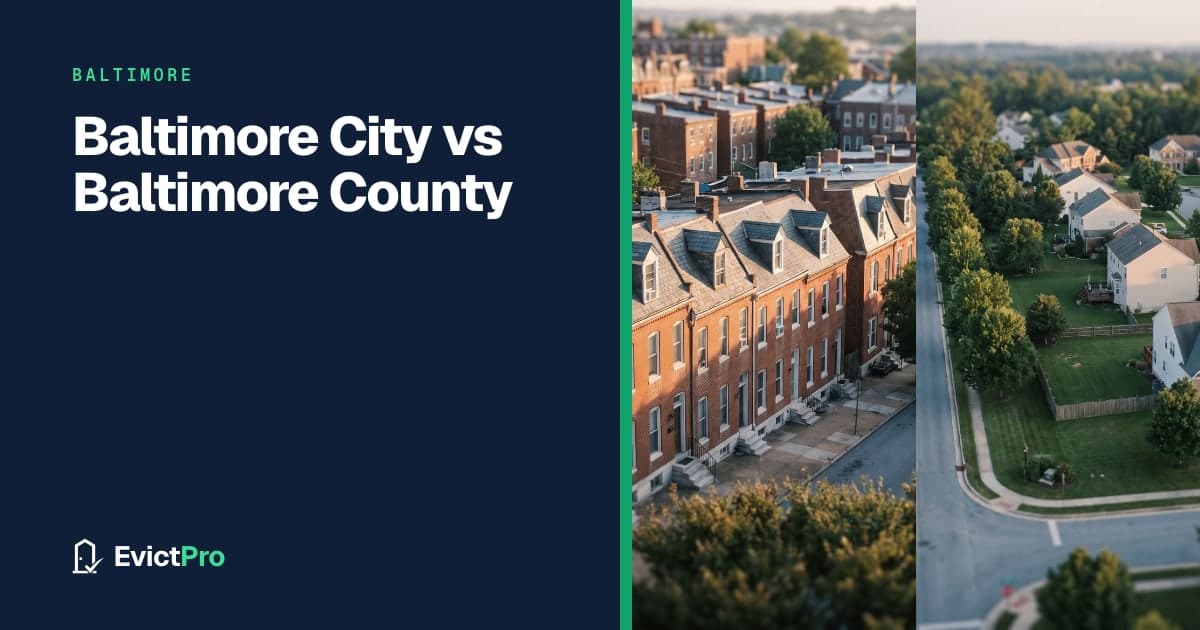
Baltimore City vs Baltimore County Eviction: The 2026 Jurisdictional Comparison for Landlords
The eviction statute is the same in both jurisdictions, but the rental license rules, courthouse logistics, docket cadence, sheriff scheduling, and local enforcement intensity diverge in ways that change timelines and dismissal risk. This is the 2026 side-by-side for landlords filing in Baltimore City vs Baltimore County.
How to Choose the Best Eviction Service in Baltimore: A 2026 Landlord's Evaluation Framework
There is no single best eviction service in Baltimore. The right path depends on case complexity, portfolio size, entity structure, and risk tolerance. This is the 2026 evaluation framework: four service paths compared on seven criteria, with the case profiles each path actually fits.
Need help with a Maryland eviction?
Start with a free, Maryland-compliant Notice of Intent. Escalate to a paid filing at $99 whenever you're ready.