
How to Choose the Best Eviction Service in Baltimore: A 2026 Landlord's Evaluation Framework
There is no single best eviction service in Baltimore. The right path depends on case complexity, portfolio size, entity structure, and risk tolerance. This is the 2026 evaluation framework: four service paths compared on seven criteria, with the case profiles each path actually fits.
On this page
Searching for the best eviction service in Baltimore usually means the landlord is past the DIY-research stage and ready to pay for help. The honest answer is that there is no single best service. The right path depends on case complexity, portfolio size, entity structure, and risk tolerance. This post is the 2026 evaluation framework: four service paths compared across seven criteria, with the case profiles each path actually fits.
Cost is the first thing landlords compare and the last thing that should decide the choice. The right path is the one that fits the case profile, the entity structure, and the dismissal risk the landlord can tolerate.
The eviction process is governed by Md. Code, Real Property § 8-401. The corporate-entity representation rule sits at Md. Code, Business Occupations and Professions § 10-206, which limits non-attorney appearances by LLCs and corporations to the small-claims threshold under § 4-405 of the Courts Article (currently $5,000). Court fees are published at mdcourts.gov/courts/feeschedules. For the broader cost analysis, see What Does a Baltimore Eviction Actually Cost in 2026?.
The Four Service Paths
Every Baltimore eviction case is handled by one of four service paths. Each fits a different case profile. Understanding the profile is the prerequisite to picking the path.
Path 1: DIY (Self-Representation)
The landlord serves the notice, files DC-CV-082, attends the hearing, files DC-CV-081, and coordinates with the sheriff. No external service. Available to individual landlords on any rent amount and to LLCs only on claims at or below the small-claims threshold of $5,000.
- Cost: Court fees only ($86 to $175 in Baltimore)
- Time cost: 8 to 15 hours per case
- Dismissal risk: Materially higher than represented cases
- Best fit: Individual landlord, 1 to 2 properties, simple uncontested cases, comfortable with procedural detail
For the full pro se framework see Can a Landlord Evict Without a Lawyer in Maryland?.
Path 2: Platform Service
A landlord-facing platform handles forms, filing, hearing representation (via an experienced agent), and procedural compliance through the case lifecycle. The platform absorbs the mechanical work; the landlord makes case decisions.
- Cost: Stage-based, typically $99 per stage to $749 end-to-end, with court fees included in the stage price
- Time cost: 1 to 2 hours per case
- Dismissal risk: Low (compliance checks built into workflow)
- Best fit: Individual landlord or LLC under $5,000, 1 to 15 properties, wants structured help without a retainer
Path 3: Independent Maryland Eviction Agent
An individual agent (not an attorney) handles filings and court appearances on a per-case fee basis. Often a former property manager or paralegal. Service quality varies widely by individual.
- Cost: $200 to $600 per case typical, plus court fees separately
- Time cost: 1 to 3 hours per case (depending on agent responsiveness)
- Dismissal risk: Varies by agent
- Best fit: Landlords who prefer a single point of contact and have an established relationship with a specific agent
Path 4: Attorney Representation
A Maryland-admitted attorney provides legal representation under attorney-client privilege, files all documents, appears in court, and advises on legal strategy. Required for LLCs and corporations on claims above the $5,000 small-claims threshold.
- Cost: $1,500 to $2,500 retainer typical for uncontested case; $3,500 to $5,000+ for contested
- Time cost: 30 to 60 minutes per case for the landlord
- Dismissal risk: Low
- Best fit: Contested cases, counterclaims, LLC above $5,000, Section 8 federal-grounds termination, or any case where legal strategy matters more than procedural execution
The Seven Evaluation Criteria
When comparing services within a path (or comparing across paths), the seven criteria below capture what actually matters in 2026.
1. Court-Fee Transparency
Does the stated price include court filing fees, or are court fees billed separately?
- Better: All-in pricing where the platform or service price covers the base court fee, with any statutory surcharge (like Maryland's $5-per-tenant filing service fee) passed through at cost. No marked-up "plus $60 filing fee" surprise.
- Worse: Service fee plus court fee plus warrant fee plus sheriff fee, billed separately, with the landlord chasing receipts.
A simple test: ask for the total cost of a Baltimore FTPR through physical eviction. If the service can answer with one number, the pricing is transparent. If they answer with "depends," prepare to add up four to six line items.
2. Stage-Based vs All-In Pricing
Does the service let the landlord pay per stage, or only as a locked-in package?
- Stage-based: Pay only for the stages used. Tenant cures after the notice? You paid for the notice ($0 with most platforms) and nothing more. Tenant defaults at hearing? You paid for filing and hearing; warrant stage optional.
- All-in package: Pay the full cost up-front regardless of whether the case settles, is dismissed, or proceeds to physical eviction.
Stage-based is friendlier for cases that settle early. All-in is simpler for portfolio managers who know every case will run the full pipeline.
3. Baltimore City Compliance Expertise
Does the service understand Article 13 rental license requirements and Maryland lead paint registration?
- Required knowledge: License number on DC-CV-082, current license at filing, lead paint inspection certificate for pre-1978 properties, October 14, 2025 courthouse relocation to 500 N. Calvert Street
- Test question: "What happens if my Baltimore rental license expired three weeks ago?" A competent service answers immediately ("renew, then refile from the 10-day notice"). An incompetent service hedges or doesn't know.
For the full Baltimore compliance picture, see Baltimore Rental License Dismissed Eviction.
4. LLC Representation Under the Small-Claims Threshold
Does the service understand the § 10-206(b)(4) restriction on LLC pro se appearance?
- Required knowledge: LLC officer or member can appear pro se only if claim is at or below the small-claims threshold under § 4-405 (currently $5,000); above that, counsel is mandatory.
- Test question: "I'm an LLC and my tenant owes $7,000. Can your service handle this?" Competent platforms route this to attorney coordination; competent attorneys take it; incompetent services try to file without counsel and the case is dismissed.
5. Section 8 and HOME Act Knowledge
Does the service understand 24 CFR § 982.310 federal grounds for HCV termination, the March 28, 2026 HUD interim rule that revoked the 30-day federal notice floor for nonpayment, and the Maryland HOME Act prohibition on source-of-income discrimination?
- Test question: "My Section 8 tenant is two months behind. Do I serve a 10-day or 30-day notice?" Correct answer post- March 2026: 10-day notice under § 8-401(c), same as market- rate.
For the full Section 8 framework, see Section 8 Eviction in Maryland.
6. Tenants' Bill of Rights Compliance
Does the service build TBOR requirements into the case workflow?
- Required knowledge: 5% late fee cap per § 8-208(d)(3), 90- day rent increase notice, TBOR attachment to every new and renewing lease, October 1, 2025 effective date
- Test question: "My lease has a $150 late fee on $2,400 rent. Is that enforceable?" Correct answer: $150 is over the 5% cap ($120), so the late fee in excess is unenforceable; reduce to $120 before claiming on DC-CV-082.
For the full TBOR walkthrough see Maryland's Tenants' Bill of Rights: Landlord Compliance Guide.
7. End-to-End Case Management vs Piecemeal
Does the service track the case from notice through eviction day, or does the landlord coordinate handoffs between stages?
- End-to-end: Single case file, single point of contact, automatic clock tracking (10-day notice, 7-business-day post- trial wait, two 60-day warrant clocks, sheriff scheduling)
- Piecemeal: Landlord re-explains case at each stage, reassembles documents, manages clocks manually
End-to-end fails less often. Piecemeal often costs the same or more once the landlord time is counted.
Decision Matrix: Which Path for Which Case Profile
| Case profile | Recommended path |
|---|---|
| Individual landlord, 1-2 properties, first FTPR, simple case | Platform or DIY |
| Individual landlord, 3-15 properties, recurring cases | Platform |
| LLC, any size, claim ≤ $5,000 | Platform |
| LLC, any size, claim > $5,000 | Attorney mandatory under § 10-206(b)(4) |
| Multi-property firm, 20+ units, routine cases | Platform |
| Multi-property firm, contested or threshold-exceeding cases | Attorney for those specific cases |
| Section 8 tenant, nonpayment | Platform (post-March 2026 timing is the same as market-rate) |
| Section 8 tenant, non-nonpayment grounds | Attorney consultation recommended |
| Tenant has counsel (Access to Counsel in Evictions program) | Attorney recommended for the landlord too |
| Habitability counterclaim raised | Attorney recommended |
How EvictPro Maps to the Evaluation Framework
EvictPro is built for the platform-service path with the seven criteria above as core design principles. Where any criterion requires going beyond platform scope (LLC above $5,000, contested cases, complex counterclaims), the platform coordinates with landlord-side attorneys rather than overreaching into legal representation.
How EvictPro answers each criterion
- Court-fee transparency: All-in pricing. Every stage price includes the court fee. No separate billing.
- Stage-based pricing: Pay only for the stages used. Tenant cures after notice? You paid $0 and nothing more.
- Baltimore City compliance: Article 13 rental license, lead paint certificate, and October 2025 courthouse address built into the platform workflow.
- LLC threshold awareness: Platform flags cases approaching or exceeding the $5,000 small-claims threshold so LLC landlords can route to counsel before filing.
- Section 8 / HOME Act: Post-March 2026 federal grounds and PHA notification workflow built into Section 8 case handling.
- TBOR compliance: 5% late fee cap enforced in rent ledger computations; TBOR attachment required for lease setup.
- End-to-end management: Single case file, single agent relationship, all clocks tracked automatically.
Stage-based pricing (court fees inclusive)
- Notice of Intent: $0. Free, no account required
- Filing with Court: $99. DC-CV-082 prep plus filing plus court fee
- Court Hearing: $249. Hearing representation plus document package
- Warrant of Restitution: $199. DC-CV-081 prep plus filing plus court fee
- Sheriff Scheduling: $75. Coordination with the sheriff's office
- Eviction Day: $225. On-site presence for the physical eviction
Or bundle with Full Eviction Service: $749. Every stage above included, end-to-end. The base court filing fee is inside each stage price. Maryland's $5-per-tenant filing service fee (DCA-109) is billed separately at cost.
For the per-stage hearing-day prep, see What to Bring to Baltimore Rent Court.
Related reading:
- What Does a Baltimore Eviction Actually Cost in 2026?
- How to Evict a Tenant in Maryland: The Complete 2026 Guide
- The Maryland FTPR Process, Step by Step
- Can a Landlord Evict Without a Lawyer in Maryland?
- Baltimore Rental License Dismissed Eviction
- What to Bring to Baltimore Rent Court
- Section 8 Eviction in Maryland
- Maryland's 5% Late Fee Cap
Ready to start a case with a platform that meets all seven criteria? Start with a Notice of Intent that costs nothing and takes ten minutes:
Jordan Walsh
Editor, EvictPro
Jordan Walsh writes about Maryland landlord-tenant law, Baltimore rental court procedure, and the operational side of running rental property in the mid-Atlantic. Focused on practical, source-cited writing for landlords and agents navigating the FTPR process. Based in Baltimore.
More posts by Jordan WalshRelated posts
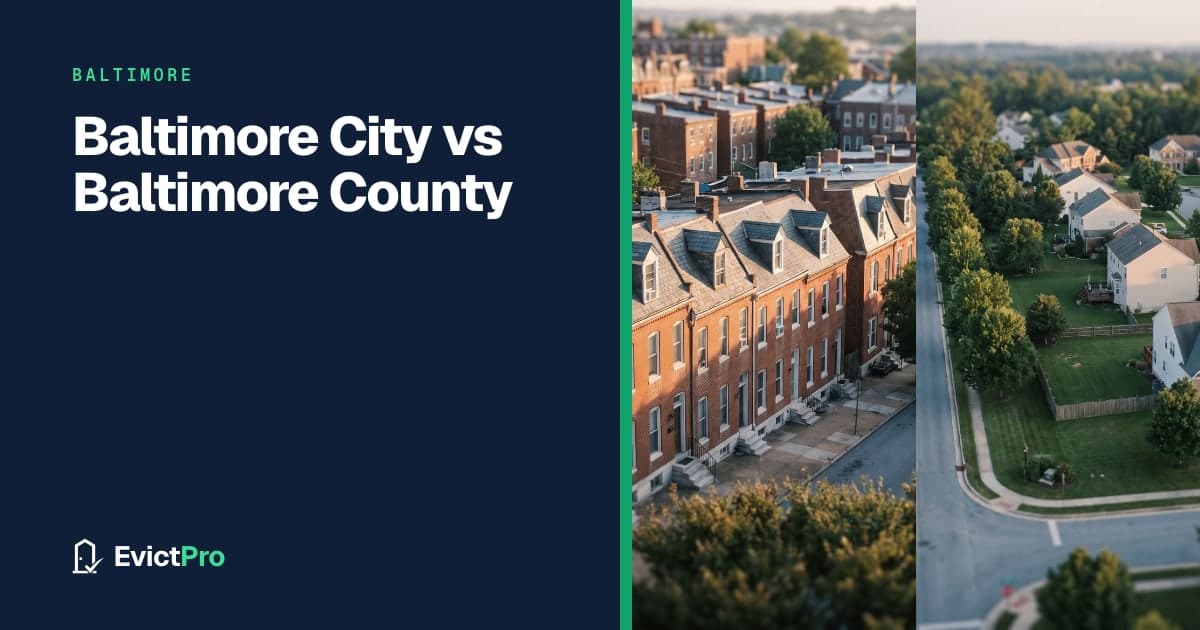
Baltimore City vs Baltimore County Eviction: The 2026 Jurisdictional Comparison for Landlords
The eviction statute is the same in both jurisdictions, but the rental license rules, courthouse logistics, docket cadence, sheriff scheduling, and local enforcement intensity diverge in ways that change timelines and dismissal risk. This is the 2026 side-by-side for landlords filing in Baltimore City vs Baltimore County.

What to Bring to Baltimore Rent Court: The 2026 Landlord Hearing-Day Checklist
Baltimore City rent court hearings are decided in five to ten minutes. Whether you win depends on what you walk in with. This is the 2026 landlord checklist, updated for the October 2025 courthouse relocation to 500 N. Calvert Street, with every document the judge expects to see and the procedural traps that catch unprepared filers.
How an Expired Baltimore Rental License Gets Your Eviction Dismissed (and How to Prevent It in 2026)
Baltimore City is the only Maryland jurisdiction where two municipal compliance items will dismiss an FTPR case at the bench: an expired rental license under Article 13 and an expired Maryland Lead Paint Inspection Certificate for pre-1978 properties. This is the 2026 walkthrough — including the Strengthening Renters' Safety Act changes effective January — for landlords filing in Baltimore Rent Court.
Need help with a Maryland eviction?
Start with a free, Maryland-compliant Notice of Intent. Escalate to a paid filing at $99 whenever you're ready.